Module 1: Introduction to 3D Printing
| Site: | OpenMoodle der Universität Bielefeld |
| Course: | BITS SPACE – 3D Printing & Modelling |
| Book: | Module 1: Introduction to 3D Printing |
| Printed by: | Gast |
| Date: | Friday, 20 November 2026, 10:05 PM |
1. What is 3D Printing?
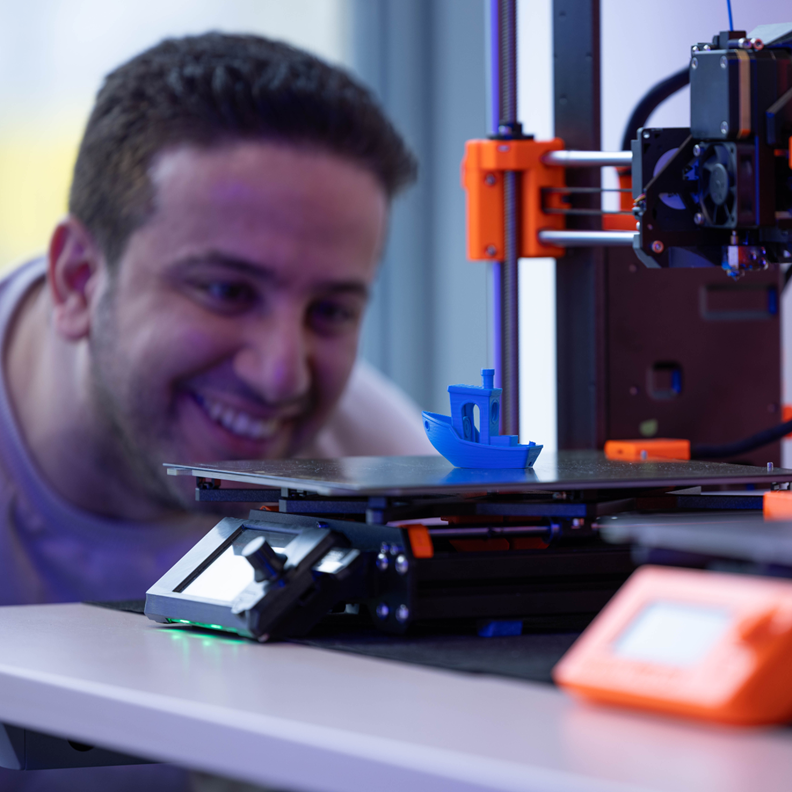
3D printing is a manufacturing method categorized as additive manufacturing. Unlike traditional subtractive methods, which involve cutting or carving material away, 3D printing constructs physical objects by adding material only where it is required according to a digital design.
2. The Layer-by-Layer Concept
The defining characteristic of 3D printing is its incremental construction method.
Slicing: A digital 3D model is mathematically “sliced” into thin, horizontal cross-sections.
Deposition: The printer follows these paths, depositing material one layer at a time.
Fusion: Each new layer is fused to the one below it as the material cools or cures.
Standard Thickness: In professional and academic settings, a layer height of 0.2 mm is frequently utilized as a standard balance between detail and production speed.
The time-lapse video of one of the 3D prints can be seen below: Nachfolgend ist das Zeitraffervideo eines der 3D-Drucke zu sehen:
3. Fused Deposition Modelling (FDM)
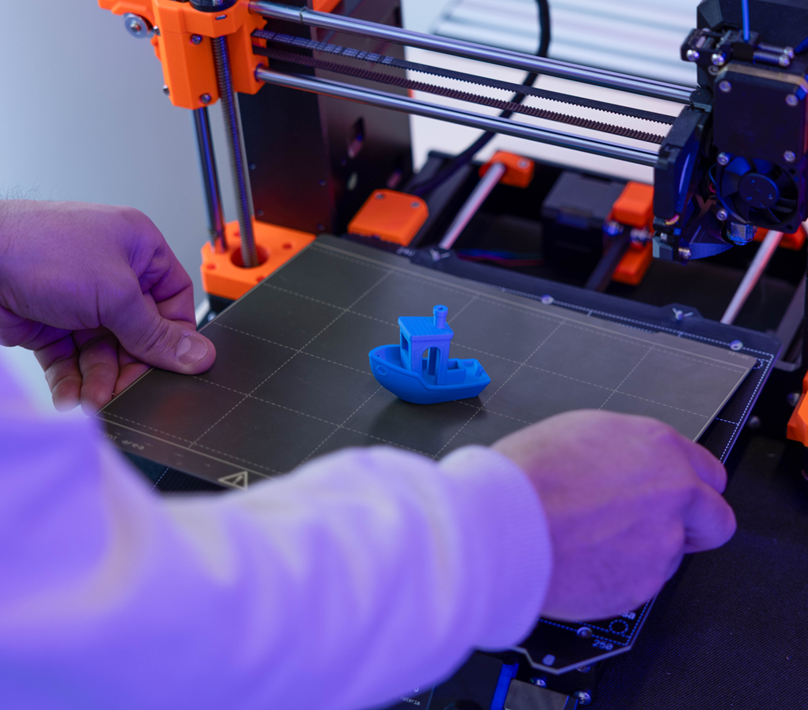
The most common technology used in 3D printing is Fused Deposition Modelling.
Extrusion: Thermoplastic filament is fed into a heated nozzle, where it is melted.
Movement: The print head moves along the X and Y axes to draw the shape of the layer, while the build plate or nozzle moves along the Z-axis to begin the next layer.
Internal Structure (Infill): To save material and time, objects are rarely printed solid. Instead, an internal lattice called infill is used. A standard density of 15-20% is typically applied for general purpose parts.
4. Common Materials
Various filaments are used depending on the mechanical requirements of the project.
PLA (Polylactic Acid): A biodegradable plastic that is the standard for beginners due to its ease of use and low warping.
PETG: A more durable and heat-resistant material often used for functional lab components or mechanical parts.
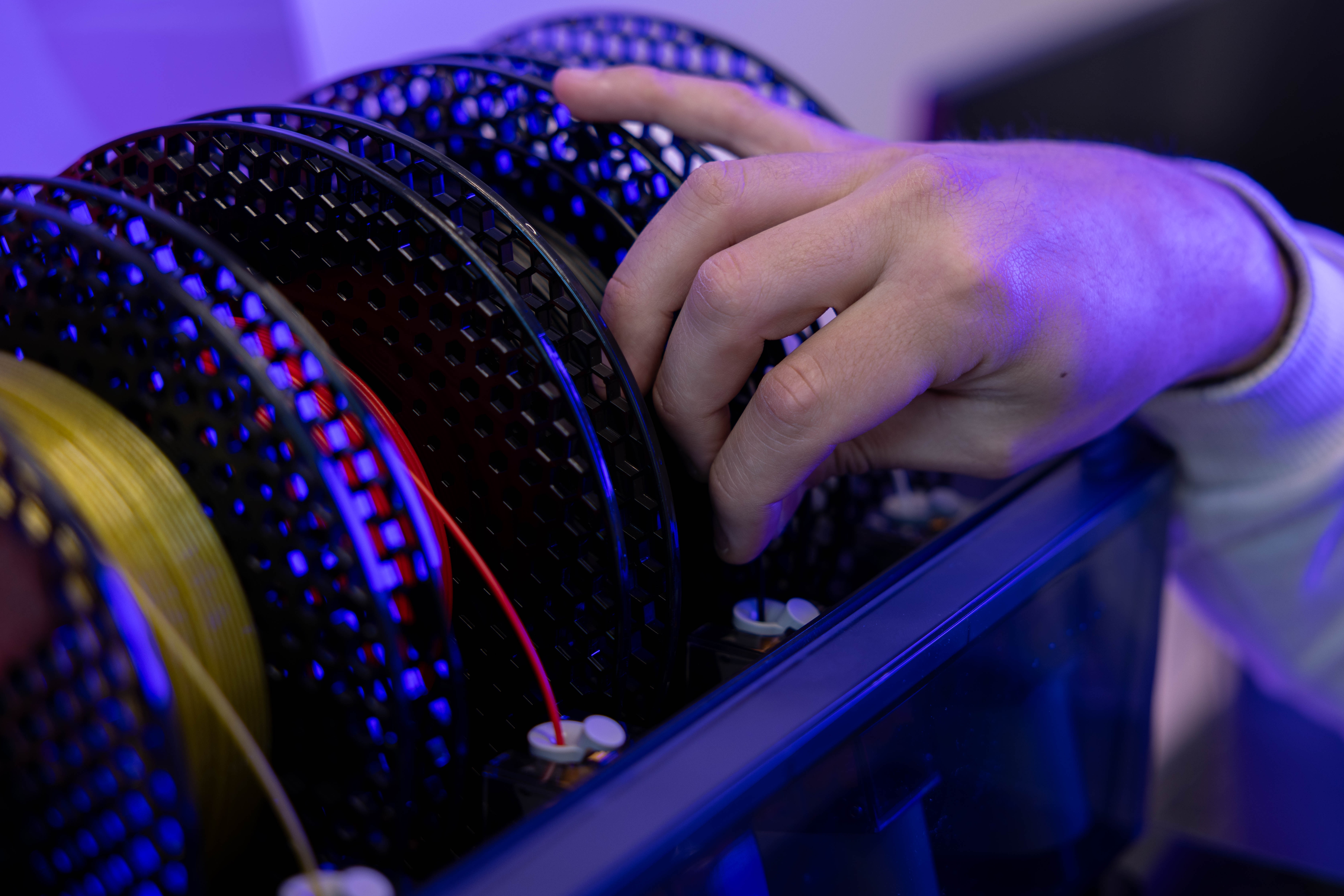
Material Selection Tip: When choosing a material, consider not only the strength but also the print difficulty. Materials like PAHT-CF or PC Blend often require specific settings or an enclosed build chamber, while PLA and PETG are very beginner-friendly and easy to use.
The following table introduces common filaments and explains their specific characteristics and typical applications. ⬇️
|
Filament |
Strength |
Flexibility |
Heat Resistance |
Print Difficulty |
Typical Applications |
|
|
PLA |
Medium |
Low |
Low (~60°C) |
Very Easy |
Prototypes, models, decorative prints, education |
|
|
PLA-CF |
High stiffness |
Low |
Low (~60°C) |
Easy–Medium |
Lightweight structural parts, aesthetic prototypes |
|
|
PETG |
Medium–High |
Medium |
Medium (~80°C) |
Easy |
Mechanical parts, containers, functional prototypes |
|
|
ABS-T |
High |
Low |
High (~100°C) |
Medium |
Automotive parts, tool housings, functional components |
|
|
PC Blend |
Very High |
Low |
Very High (~110°C+) |
Hard |
Engineering parts, industrial prototypes |
|
|
PAHT-CF |
Extremely High |
Low |
Very High (~150°C) |
Hard |
Structural components, tooling, automotive parts |
|
|
FilaFlex 40 |
Medium |
Very High |
Medium |
Medium |
Phone cases, soft grips, wearables |
|
|
FiberFlex 40D |
Medium |
High |
Medium |
Medium |
Flexible mechanical parts, vibration dampers |
|
|
PVA |
Low |
Low |
Low |
Medium |
Water-soluble supports for complex prints |
|
|
PVB |
Low–Medium |
Low |
Low |
Easy |
Transparent decorative prints, lamps, visual models |
|